


Hydroforming forms tubes or sheets by driving metal into a tool cavity using controlled internal fluid or gas pressure. With a customer-supplied fixture, specified pressure-temperature curves are executed and logged; pre-testing can verify sealing and define a repeatable process window.
Hydroforming
Molding your Parts to Perfection
Hydroforming lives or dies by control of pressure, temperature, timing, and a fixture that seals properly. Hydroforming shapes metal by using pressurized fluid (or gas) to drive material into a tool form. However, in tube hydroforming, pressure expands a tube inside a closed die. In sheet hydroforming, pressure acts through a flexible diaphragm or directly through fluid to form a blank over a tool. Poppe + Potthoff Maschinenbau supports hydroforming projects where process discipline matters: specification-based pressure application, optional temperature control, safe fixture integration, and repeatable execution. In many cases, our customers already own the forming fixture or tool. Therefore, we design the pressure generation, control system, media handling, safety concept, and documentation around that fixture. Resulting in the process running the same way every cycle. If the process window is not yet defined, we can start with pre-testing and develop the pressure-time (and temperature) recipe before the final system is built.
What is hydroforming, and where is it used?
Hydroforming is used when conventional forming creates too many joints, too many steps, or too much compromise. Typical reasons include:
Two variants cover most industrial applications:
The workflow we see most often: you supply the fixture, we supply the process package
Scenario A — Customer-supplied fixture/tooling
If you already have the fixture, we integrate it into the system architecture and validate the interfaces:
From there, the hydroforming cycle is executed as a defined recipe:
Scenario B — Fixture exists, but the process window is still open
Sometimes the hard part is not building hardware, but defining what “stable hydroforming” looks like for your part and material. In that case, we start with pre-testing:
This reduces risk, especially when the part can’t tolerate trial-and-error on a production cell.
Hydroforming project phases (Poppe + Potthoff Maschinenbau)
check
curves
validation
window
pressure/temperature
recipe
requirements
+ controls
fixture
handover
Mapping our pressure-test capabilities to hydroforming
|
Pressure-test stand capability (P+P proof point) |
Why it matters in hydroforming (what it enables) |
|---|---|
|
Programmable pressure curves (ramp, hold, reduction) on burst rigs |
A hydroforming “recipe” is pressure-over-time; controlled ramps and holds support calibration and repeatability. |
|
High-rate measurement (example: 100,000 data points/sec on burst rigs) |
Captures transient events (seal slip, sudden thinning/splits, valve actions) and makes troubleshooting faster. |
|
Component temperature conditioning (example range shown for burst rigs: -60°C to +180°C) |
Supports specified process temperatures and repeatable results under thermal boundary conditions. |
|
Media & ambient temperature control and recipe-based testing on cycle rigs |
Transfers directly to hydroforming trials where temperature stability and process repeatability define the usable window. |
|
Heated/cooled media + programmable test setups on leak test rigs |
Mirrors real hydroforming media preparation/conditioning and allows controlled fill/hold/decay sequences. |
|
Pressure intensifiers and controlled pressure generation (“stable and repeatable conditions”) |
Hydroforming frequently uses intensification and tight control to follow the load path without bursting or buckling. |
|
Fixture integration: customer fixture or P+P-designed fixture |
Hydroforming success depends on sealing and clamping interfaces; the system must be engineered around the fixture, not bolted on later. |
Test as a Service
We also offer tests in various pressure ranges as a service. Whether for research and development or serial production, please contact us with your testing requirements for a non-binding offer.
PRESSURE TEST BENCHES AND APPLICATIONS
PRECISE, REPEATABLE AND RELIABLE
As a specialist in pressure testing technology and state-of-the-art test rigs, Poppe + Potthoff Maschinenbau supports the development and production of particularly resilient components made of various materials – especially for automotive, shipbuilding and mechanical engineering as well as fluid and the medical industry. We offer individually designed test benches such as burst pressure test rigs, pressure cycle test benches, leak test systems, functional test rigs and autofrettage systems.
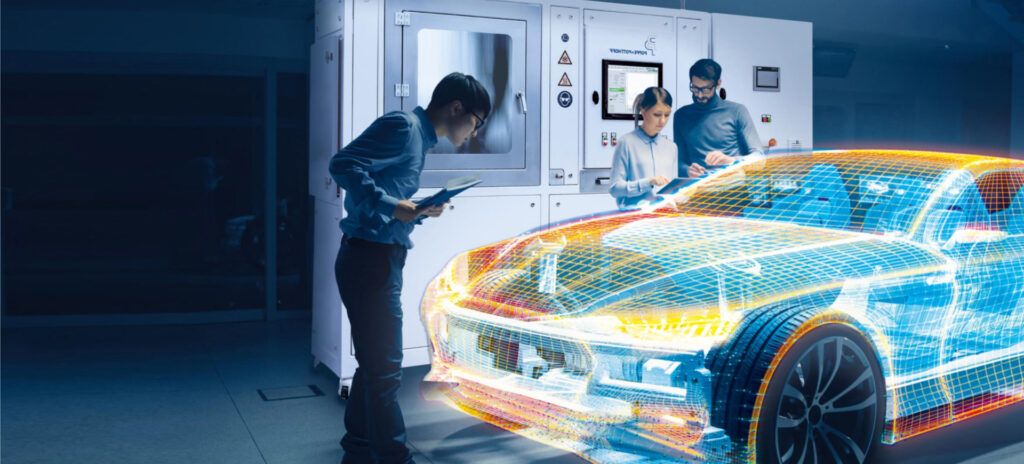
Pressure change test stand with vacuum testing
Subject cooling systems of ECUs, PTC heaters, high-voltage coolant auxiliary heaters, ACDC and DCDC converters, and other media-carrying components to pressure tests while controlling the ambient and media temperature of, for example, water-glycol at temperatures from -40 °C to 140 °C.

Function test stand: battery simulation under the influence of temperature
For functional testing of media-carrying components, a temperature-controlled volume flow (e.g. 30l/min) can be generated with the Poppe + Potthoff test benches. In addition, a component from e-mobility can be energized if required.
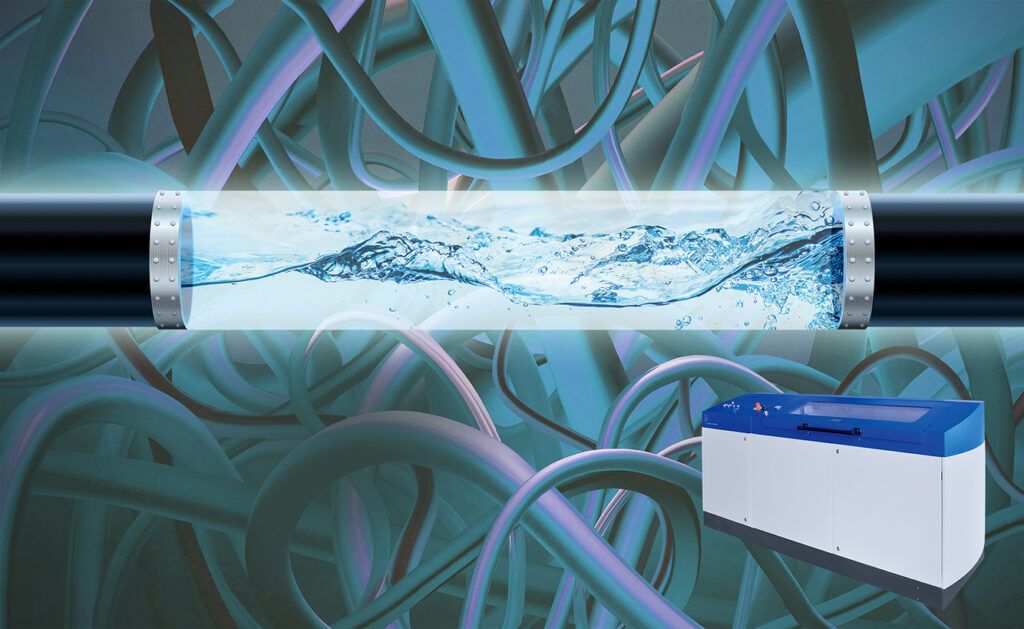
Leakage test stand
Poppe + Potthoff leak test stands can be used to test various components and assemblies for leaks by means of a pressure drop. Depending on the test requirement, our systems can be designed including vacuum unit and low pressure or high pressure module for optimal leak testing. In addition, Poppe + Potthoff offers e.g. bubble tests in a water bath / underwater tests with air and gas.
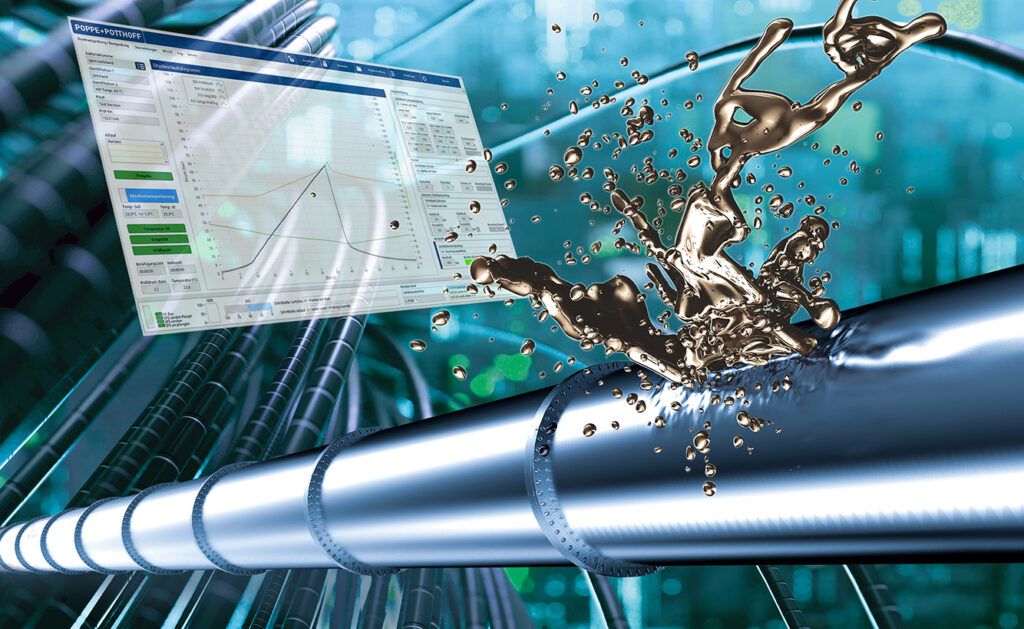
Bursting pressure test rig < 200 bar
To prove the quality of media-carrying components, hose lines, pipes, pressure vessels and other components are pressurized until they burst.
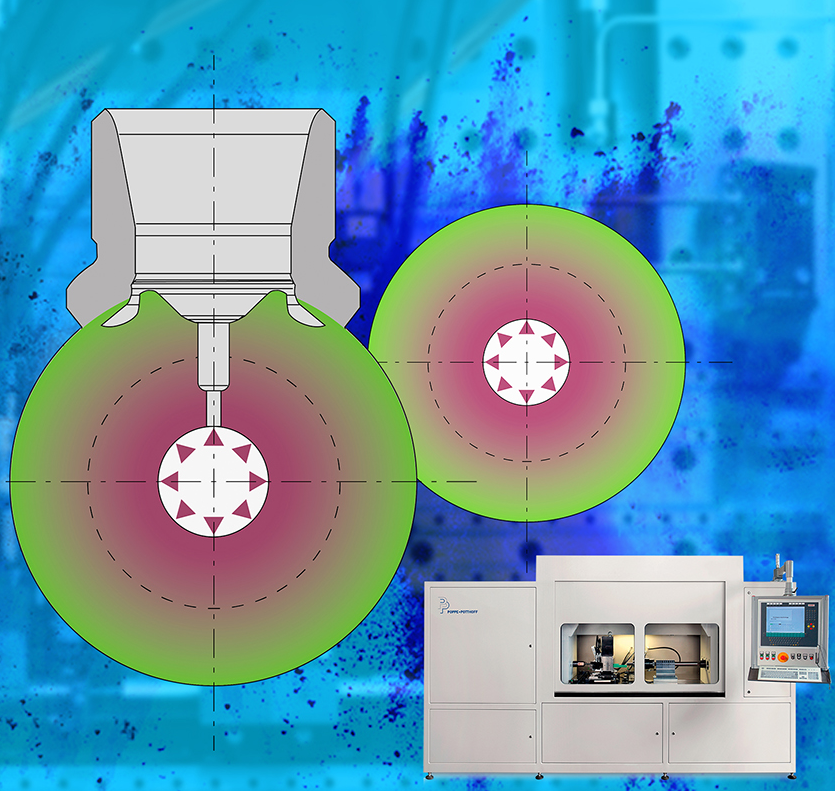
Bursting pressure test rig < 200 bar
A flexible and expandable system for performing autofrettage on various components such as common rails and pump heads up to 12,000 bar.
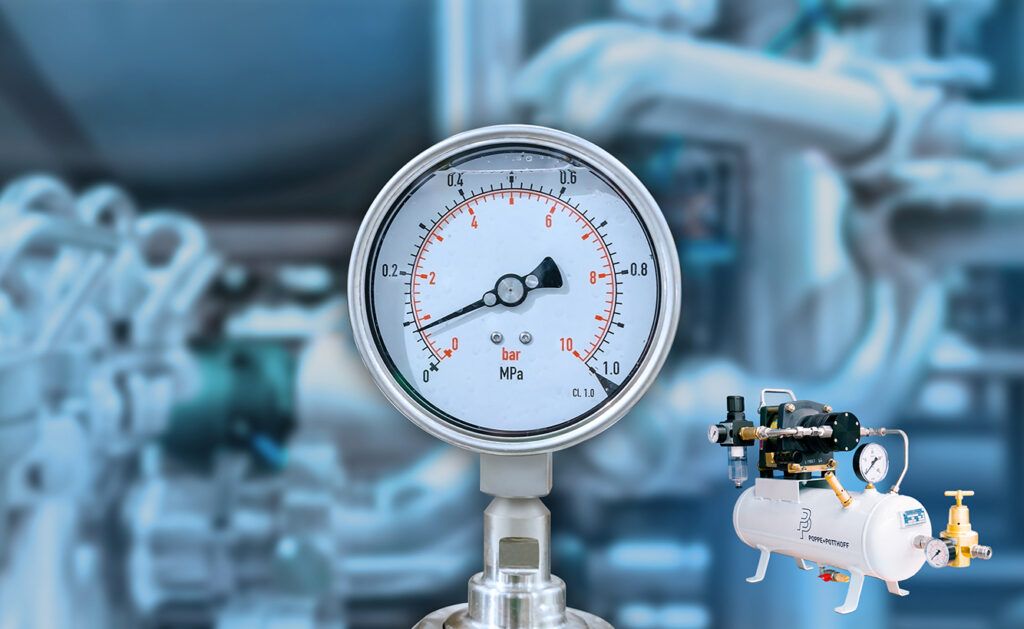
Compressed air booster
Poppe + Potthoff Maschinenbau GmbH supplies compressor units and pressure control systems up to 400 bar. We offer ready-to-connect units to increase the existing pressure for pneumatic and hydraulic applications. This allows the performance of already existing plants to be expanded flexibly and efficiently.
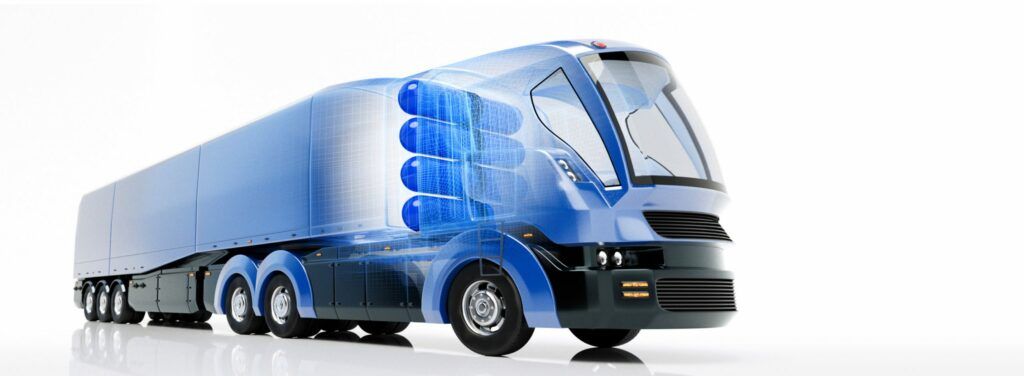
Test bench for H2 components
We offer pressure testing equipment for the development and validation of hydrogen and nitrogen components. The focus is on test benches in the area of pressure cycling, burst pressure testing, and hydrostatic strength testing.
1050 Bar Helium / Nitrogen / Hydrogen
A leak test bench equipped with a pressure module up to 1050 bar, an optional integrated climate chamber and a gas sniffer (e.g. Inficon) to detect leakage on H2 components such as ontank valves, hoses, pipes, fittings, regulators, valves and fuel cell components.
Automotive
Automotive testing involves a wide range of tests. Poppe + Potthoff Maschinenbau supports the industry with state-of-the-art pressure test benches, autofrettage systems and functional test benches.

Aerospace
Test systems from Poppe + Potthoff Maschinenbau put fluid systems and components for aerospace applications to a tough test. In the service life test, they undergo millions of pressure load cycles to simulate the service life of a component.
Home Appliances
Household appliance manufacturers are aware of the importance of ensuring that their media-carrying components are leak-proof from day one and that components can withstand a pressure load higher than the operating pressure. Poppe + Potthoff Maschinenbau supports the industry with various pressure testing systems.
Medical Technology
Test benches for medical technology components from Poppe + Potthoff Maschinenbau put a wide variety of components to the test. Reliable, repeatable and accurate pressure tests and test processes ensure the quality of a component during research and development.

Shipbuilding
Marine engines are composed of components that are exposed to high pressures and require pressure testing of any kind. Cooling systems, pumps and valves of marine engines are exposed to pressure and are tested for their load capacity with pressure test benches from Poppe + Potthoff.

Oil and gas
Various components from the oil and gas industry can be tested on pressure test benches from Poppe + Potthoff. Drill pipes, tubes and (gas) valves are components that are exposed to changing pressure and temperature conditions and require pressure testing to ensure quality and safety.
Contact Us
Our experienced technical sales team will help you implement your project and find a solution tailored to your specifications and requirements. We are represented internationally and can support you and your company worldwide. Our team has completed hundreds of projects many of which involved supporting test facilities with identical equipment. P+P Maschinenbau is your internationally trusted partner.
Expertise, excellent knowledge of the market and affinity for our products guarantee our success.