




Reproducible Burst Pressure Testing for Plastic Housings Improves Data Quality and Process Stability
Burst pressure testing is a destructive test method used to determine the maximum pressure a component can withstand. For plastic housings, burst pressure testing typically requires a reproducible, precisely controlled pressure ramp to clearly identify the actual burst point.
– Maximilian Krieg // Poppe + Potthoff Maschinenbau GmbH
Unstable pressure curves near the failure threshold are a commonly underestimated problem in burst pressure testing of plastic housings and plastic components in general. They make it difficult to clearly determine the burst pressure and significantly reduce the reliability of the test data. Precise, reproducible pressure curves — particularly in the critical range just before component failure — are essential for drawing meaningful conclusions about component quality and process stability.
Bürkert Fluid Control Systems develops and manufactures fluid control and automation components for industrial applications worldwide. These components are used across a wide range of applications where media flows must be controlled with precision and where reliability and leak-tightness requirements are high.
Why Burst Pressure Testing Matters for Quality Assurance
Quality assurance processes commonly test plastic housings that are later installed in valves and other assemblies. These housings play a central role in the overall system, since they must withstand both mechanical loads and media-specific requirements. Their reliability has a direct impact on the functional safety of the entire assembly.
Burst pressure testing is a key method here. As a destructive test, it provides direct insight into a component’s maximum load capacity — and therefore into its available safety margin. Unlike leak or function testing, burst testing enables a direct assessment of the mechanical failure limit and serves as a reference point for component design and validation. Quality assurance plays a central role in this context, since even small deviations in component behavior can affect the function and service life of the finished part. For plastic housings in particular, a reproducible pressure ramp is critical: only a controlled pressure increase reliably reveals differences in material behavior or the manufacturing process.
Limitations of the Previous Test Setup and Resulting Requirements
The previous test environment relied on a conventional pump-based test rig. In practice, this setup showed a system-related weakness: pressure instabilities and irregularities in the pressure rise repeatedly occurred just before the burst pressure was reached. These instabilities meant pressure curves were only partially comparable, and in some cases the actual burst pressure could not be clearly determined. At the same time, the informative value of the test data was limited, since the critical range immediately before component failure was not run through in a reproducible way.
This created a clear requirement: establish a test solution capable of stable, reproducible pressure build-up all the way to the burst point, while delivering consistent, analyzable pressure curves — providing a reliable data foundation for quality assessment and further process analysis.
Controlled Pressure Generation and a Stainless Steel Burst Tank as the Solution
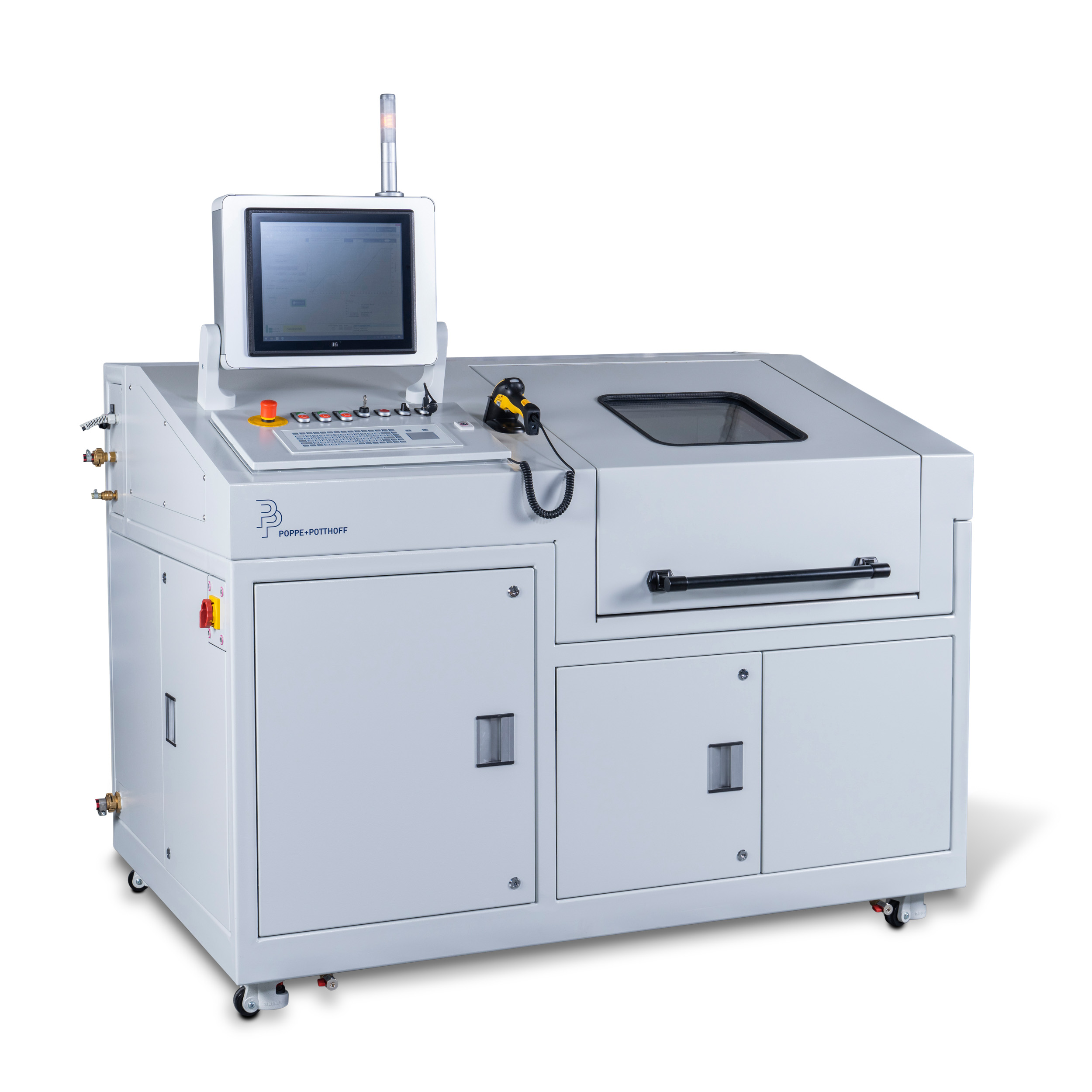
In 2021, Poppe + Potthoff Maschinenbau GmbH designed and implemented a hydraulic burst test rig featuring controlled pressure generation. The system is based on a hydraulically driven pressure intensifier that enables a smooth, controlled pressure increase across the entire test range. The rig uses water as the test medium and is rated for pressures up to 200 bar.
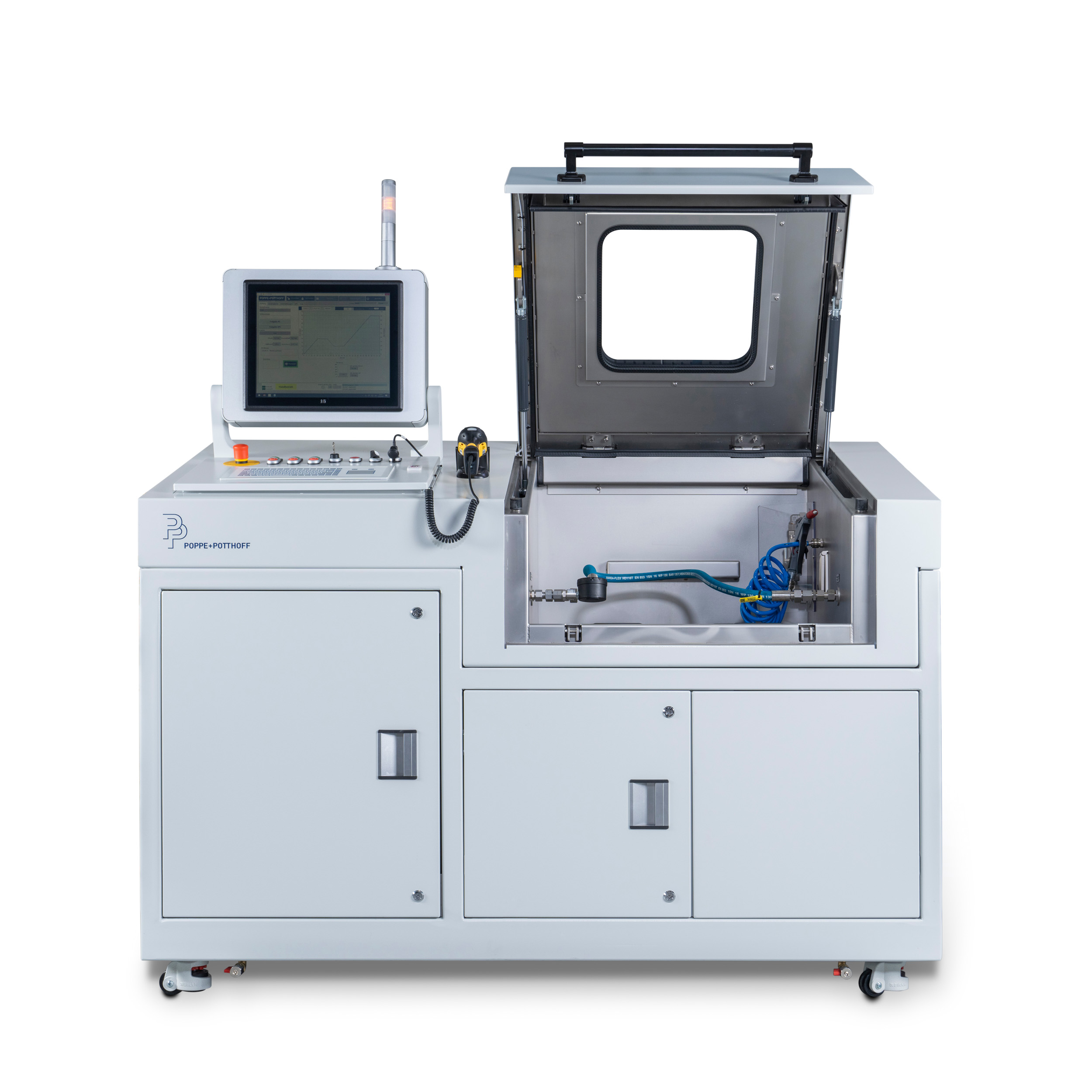
The burst tank tests plastic housings for fluid control systems, which are manually loaded into the rig. The test sequence includes an automated pre-fill process, the actual pressure test, and subsequent data evaluation. Testing takes place inside a stainless steel safety chamber with a viewing window. One specimen is processed per test, and the rig is designed for daily use in quality assurance. Compared with the previous solution, the key difference lies in the stability of the pressure build-up: while conventional pump systems tend toward instability near the failure threshold, controlled pressure generation enables a continuous, reproducible pressure ramp all the way to component failure.
Improved Reliability of Test Results
With the new test rig, the reliability of burst pressure testing improved significantly. Tests now show a high degree of repeatability. Pressure curves can be captured consistently and compared directly with one another, creating a solid basis for component evaluation. The critical range just before failure can now be run through in a stable manner, allowing the burst pressure to be clearly determined — increasing the accuracy of test results and reducing room for interpretation.
Data analysis has also improved. Deviations in component behavior become immediately apparent and can be systematically analyzed, enabling early detection of changes in materials or manufacturing processes. In practice, this gives burst pressure testing an expanded role: it no longer serves solely as proof of component strength, but is developing into a process monitoring tool. Changes in burst pressure behavior can be used as an indicator of deviations in material batches or manufacturing processes.
Example pressure curve: does not represent the actual curve from Bürkert Fluid Control Systems (confidential)
Applicable Beyond This Case
This application demonstrates that the quality of burst pressure testing depends heavily on the stability of the pressure build-up. A reproducible pressure ramp is the prerequisite for comparable results and reliable conclusions about component quality. These requirements are not limited to this specific case. Similar conditions apply wherever pressure-loaded plastic components are used — for example in medical technology, water treatment, or the chemical industry. In these fields, the combination of controlled pressure generation and reproducible test methodology is essential both for ensuring component safety and for drawing conclusions about the stability of manufacturing processes.
We would like to thank the team at Bürkert Fluid Control Systems for the excellent and trusted collaboration on this project.
Further reading:
Bürkert Fluid Control Systems – official website
Download the complete case study as a PDF: Burst Pressure Testing at Bürkert